GEO vs SEO: the 2026 playbook for content teams

GEO vs SEO stopped being a debate the moment AI Overviews started answering the question before the click. The two disciplines share a foundation — crawlers, structure, authority — but they optimize for different outcomes: GEO earns a mention inside an AI-generated answer, while SEO earns the ranked link. This playbook walks through what changed, the end-to-end workflow that serves both, and the traps that quietly kill AI visibility.
What GEO vs SEO looks like in 2026
Two years ago, GEO was a conference-track curiosity. In 2026 it sits next to SEO on the same content calendar, because the same query can now resolve in three different places: a blue link, an AI Overview, or a chat answer inside ChatGPT, Claude, Perplexity or Gemini. The traditional SEO playbook alone no longer covers all three surfaces.
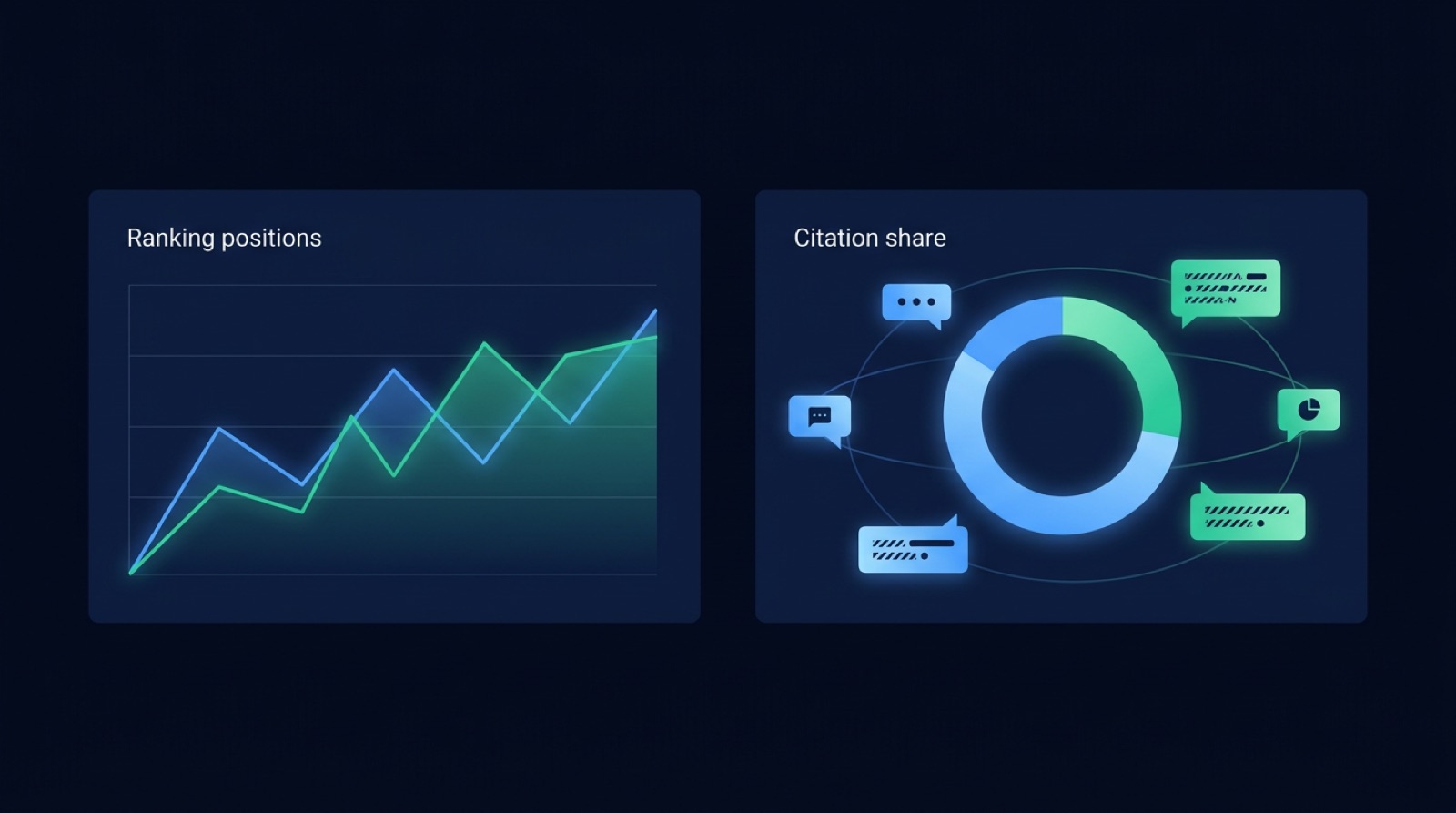
The cleanest way to frame the split is by output. SEO optimizes for a position — a rank on a results page. GEO optimizes for a citation — a sentence, a statistic or a named brand inside an answer that a model assembled from multiple sources. Ranking #1 and being cited are correlated but not identical; a page can rank well and still never get quoted, because the model chose a competitor's cleaner definition.
What changed in the last twelve months is the plumbing. Answer engines now read a broader set of signals than classic crawlers did: chunked passages rather than whole pages, entity relationships rather than keyword density, and machine-readable files like llms.txt that tell AI crawlers what a site is about. Content teams that treated these as optional are now retrofitting them under deadline.
Why teams care now
The forcing function is simple: the click is no longer guaranteed. AI Overviews and chat assistants answer a growing share of long-tail queries inline, which means a page that ranks but is not structured for extraction can be read by the model and still send zero sessions to the site. For SaaS and ecommerce teams, that shows up as a flat organic line on a dashboard that used to climb every quarter.
Three concrete pressures are pushing GEO onto the roadmap:
- Zero-click answers. Definitional and comparison queries — the ones that used to feed top-of-funnel traffic — increasingly resolve inside the answer box.
- Attribution blind spots. Standard analytics setups struggle to credit AI-sourced visits, which makes GEO look unmeasurable until you instrument it. The GA4 visibility gap is a known problem, not a reason to ignore the channel.
- Brand mentions as ranking signal. Models lean on consensus. If your brand is not mentioned across the sources they retrieve, you are not in the candidate set.
The practical takeaway: GEO is not a replacement for SEO. It is a second extraction layer on top of the same content, and the teams that treat it that way ship faster than the ones building a parallel content operation.
The end-to-end workflow, broken down
Running GEO and SEO together is a five-stage loop. Each stage produces an artifact the next stage consumes, which is what keeps the work from doubling.

Stage 1 — Map queries by answer type
Start by sorting your target queries into two buckets: link queries (transactional, navigational, and anything where the user needs to land on a page) and answer queries (definitions, comparisons, how-tos, statistics). Link queries stay on the classic SEO track. Answer queries get GEO treatment — a clean definition, a scannable structure, and a quotable line near the top.
Decisions to make:
- Which queries already trigger an AI Overview or chat answer for your audience?
- Which of those queries do you actually want to be cited in, versus which ones you want to win the click for?
- Which pages currently serve both intents badly and need to be split?
Stage 2 — Build the semantic cluster
GEO rewards entity coverage, not keyword repetition. That means one pillar page supported by tightly related cluster pages, all cross-linked, all describing the same topic from different angles. A model retrieving your pillar is far more likely to cite you if it can also see three supporting pages that confirm the same facts.
Decisions to make:
- What is the one-sentence definition your pillar should own?
- Which sub-questions become cluster pages?
- Where do internal links carry the reader from a definition to a deeper explainer?
Stage 3 — Structure pages for extraction
This is where GEO diverges most sharply from SEO. Extraction-friendly pages lead with the answer, then support it. Headings mirror the question. Tables compare options side by side. FAQ blocks answer the follow-ups a reader would actually type next. Schema markup — Article, FAQPage, ItemList — makes the structure machine-readable rather than just human-readable.
Decisions to make:
- Does the first 50 words of each section answer the heading, or does it warm up first?
- Are comparisons in a table, or buried in prose a model has to parse?
- Which pages need FAQPage schema, and which need ItemList?
Stage 4 — Publish machine-readable context
Answer engines increasingly look for signals beyond the HTML page. Serving an AGENTS.md file alongside llms.txt tells crawlers what the site covers and how to interpret it. For Shopify and SaaS teams, this is a low-effort, high-signal layer that most competitors still skip.
Decisions to make:
- Which pages belong in llms.txt as canonical topic references?
- What does AGENTS.md declare about brand, products and preferred citation?
- Who owns keeping these files current as the site changes?
Stage 5 — Measure citations, not just rankings
Rank tracking still matters, but it is no longer the whole scoreboard. The metrics that matter for GEO are citation frequency (how often you appear in AI answers for target queries), share of voice inside those answers, and — where instrumentation allows — the revenue attributed to AI sources. SeoAiX, for example, tracks an AEO score built from semantic relevance and citation probability, and closes the loop with Search Console and GA4 data so AI-sourced revenue stops hiding.
Decisions to make:
- Which queries do you sample weekly for citation presence?
- How do you separate AI-sourced sessions from direct traffic?
- What is the review cadence — weekly, biweekly, monthly?
Pro tip: before you write a single new page, run your top twenty answer queries through ChatGPT, Perplexity and Google's AI Overviews and log who gets cited. That snapshot becomes your baseline — and it usually reveals two or three competitors you did not expect to be losing to.
What good looks like (and what to avoid)
High-performing GEO programs share a recognizable shape. The pages are short on preamble and long on specifics. Definitions sit in the first sentence of a section. Comparisons are tabular. Statistics carry a source. Headings use the language of the query. And the whole cluster reads like one author wrote it, because a model citing you is effectively vouching for coherence.
Four anti-patterns show up again and again:
- Keyword-stuffed intros. Models chunk pages by passage; a warm-up paragraph that repeats the keyword five times gets ignored, not rewarded.
- Buried answers. If the definition is in paragraph four, the model will quote paragraph four of a competitor instead.
- Schema drift. FAQPage markup that no longer matches the visible FAQ is worse than no markup at all.
- Orphan clusters. A pillar with no cluster pages reads as a single opinion rather than a topic the site owns.
A useful sanity check: read your top page aloud and ask whether a stranger could quote a single sentence from it without context. If not, the page is not extraction-ready.
Tools and approaches: a tour of the landscape
There is no single tool that does GEO and SEO end to end. Most teams assemble a stack from three categories.
| Approach | Best for | Typical strength | Typical gap |
|---|---|---|---|
| In-house workflow (docs, spreadsheets, manual schema) | Small teams with one strong writer and a technical editor | Full control, no per-seat cost | Does not scale past a handful of clusters; schema drifts |
| Classic content optimizers (Surfer, Clearscope, Frase, MarketMuse, NeuronWriter, Scalenut, Content Harmony) | Keyword and semantic coverage on individual pages | Strong on-page scoring and brief generation | Limited citation tracking and AI-answer attribution |
| Entity and schema platforms (InLinks, WordLift, PageOptimizer Pro) | Structured data and internal-link automation | Entity mapping and schema injection | Does not own publishing or ranking correction |
| Autonomous SEO/AEO engines (SeoAiX and similar) | Teams that need publishing, schema and correction in one loop | Semantic clustering, schema injection, real-time ranking correction, AI-source attribution | Requires trust in automation; less suited to heavily bespoke editorial |
The honest framing: most teams end up with two layers — an optimizer for briefs and an automation layer for schema, publishing and measurement. SeoAiX fits the second layer, and it is one option among several. If your bottleneck is editorial judgment, a classic optimizer plus a disciplined writer may be enough. If your bottleneck is throughput and consistency, an automation layer pays for itself faster.
Whichever route you take, the underlying loop is the same: define the entity, structure the page, publish the context, measure the citation. Tools compress the loop; they do not replace it.
Common questions
Is GEO replacing SEO in 2026?
No. GEO is an additional layer on top of the same content foundation. Classic SEO still drives transactional and navigational traffic; GEO earns citations in AI-generated answers. Most teams run both from one content operation.
Do I need a separate GEO content calendar?
Not usually. The same pillar-cluster structure serves both disciplines. What changes is the page structure — extraction-friendly pages lead with the answer and use tables and FAQ blocks a model can quote.
Which schema markup matters most for GEO?
Article, FAQPage and ItemList cover the majority of cases. Article establishes the page as a citable source, FAQPage exposes question-answer pairs, and ItemList helps comparison and roundup pages. Schema must match the visible page content or it loses its signal.
How do I measure GEO performance?
Track citation frequency and share of voice inside AI answers for your target queries, then reconcile that with revenue attributed to AI sources. SeoAiX exposes an AEO score and attributes revenue to ChatGPT, Claude, Perplexity and Gemini; the GA4 attribution gap is a known problem worth instrumenting.
What is the difference between GEO, AEO and LLMO?
The labels overlap. GEO (generative engine optimization) focuses on AI-generated answers, AEO (answer engine optimization) on featured snippets and answer boxes, and LLMO (large language model optimization) on how models represent your brand. In practice the workflow is largely the same — clean structure, clear entities, machine-readable context.
How long before GEO shows results?
Citation changes tend to lag ranking changes. Expect four to twelve weeks before a well-structured page starts appearing in AI answers for its target queries, depending on how competitive the topic is and how quickly models refresh their retrieval.
Do small teams need GEO at all?
If your audience asks questions your competitors are already answering inside AI tools, yes. The barrier is lower than it looks — a single well-structured pillar with FAQ schema and an llms.txt file can move the needle before you invest in a full platform.
What is the single highest-leverage GEO change?
Rewrite the first 50 words of every priority page to answer the heading directly. It is the cheapest structural change with the largest effect on whether a model can quote you.
What's changing in the next 12 months
Two shifts are worth planning for. First, machine-readable context files — llms.txt, AGENTS.md and their successors — will move from optional to expected, the way robots.txt and sitemaps did a decade ago. Second, citation tracking will become a standard dashboard metric alongside rank and traffic, because teams will refuse to run a channel they cannot measure. The research on citation levers points the same direction: structure and clarity, not volume, decide who gets quoted.
If you want a starting point, run a free audit against your priority pages, or see how the loop works before committing to a stack. GEO vs SEO is not a choice between two futures — it is a choice about how many surfaces your content can reach.